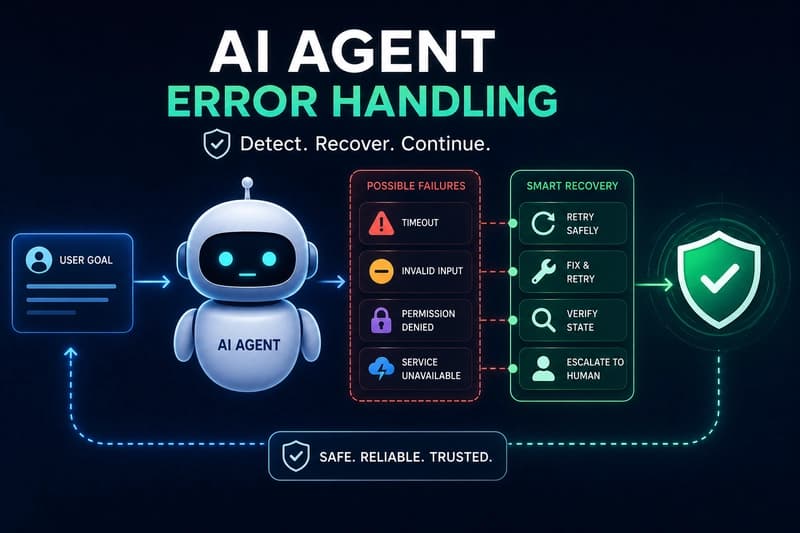
Something failed ↓ Retry It looked reasonable. APIs fail. Networks time out. Models occasionally return malformed output. Just retry the operation and continue. Then we started thinking about what happens when the agent performs real acti...
The first version of our AI agent had a surprisingly simple error-handling strategy:
Something failed
↓
Retry
It looked reasonable.
APIs fail.
Networks time out.
Models occasionally return malformed output.
Just retry the operation and continue.
Then we started thinking about what happens when the agent performs real actions.
Imagine the agent calls:
send_email()
create_ticket()
update_customer()
issue_refund()
schedule_meeting()
It calls issue_refund().
The request times out.
What does that mean?
A. The refund never happened.
B. The refund happened, but the response was lost.
C. The refund is still processing.
D. The service received the request but failed midway.
If the agent automatically retries, option B becomes particularly interesting.
We may have just issued the refund twice.
That was when AI agent error handling stopped looking like:
try:
run_agent()
except:
retry()
and started looking much more like distributed systems engineering.
A production agent doesn't merely need to recognize failure.
It needs to answer a harder question:
What state is the world in after that failure, and what is the safest thing to do next?
That distinction changed how we designed the entire agent runtime.
The Happy-Path Agent Is Easy
Most agent demos follow roughly this loop:
User Goal
↓
LLM Reasons
↓
Select Tool
↓
Execute Tool
↓
Observe Result
↓
Continue Reasoning
↓
Final Answer
For example:
User:
"Find the customer's unpaid invoice
and email them a reminder."
Agent:
1. Find customer
2. Query invoices
3. Find unpaid invoice
4. Generate reminder
5. Send email
6. Report success
Beautiful.
Until step 2 returns 503.
Or step 3 returns malformed JSON.
Or step 5 succeeds but times out before acknowledging it.
Or the model invents an invalid email parameter.
Or the agent sends the message and then loses its state.
The real architecture is closer to:
┌── Success ──────────────┐
│ ↓
Agent → Tool → Result → Validate → Continue
│
├── Timeout
├── Rate Limit
├── Invalid Input
├── Permission Denied
├── Partial Success
├── Unknown State
└── Permanent Failure
Those failures should not all produce the same response.
That was our first important design decision.
Failure Is Data
The worst tool interface for an agent looks like this:
{
"success": false,
"message": "Something went wrong"
}
What exactly should the agent do with that?
Retry?
Change the parameters?
Use another tool?
Ask the user?
Stop?
The error contains almost no actionable information.
We moved toward treating failures as structured observations.
For example:
{
"status": "error",
"code": "RATE_LIMITED",
"retryable": true,
"retry_after_ms": 3000,
"message": "API request limit exceeded"
}
Compare that with:
{
"status": "error",
"code": "INVALID_EMAIL",
"retryable": false,
"field": "email",
"message": "Email address is invalid"
}
Now the runtime can make different decisions.
RATE_LIMITED
↓
Wait + Retry
INVALID_EMAIL
↓
Correct Input / Ask User
This is the foundation of reliable agent recovery:
Classify before recovering.
Our Error Taxonomy
We eventually stopped thinking about “tool errors” as one category.
We divided failures into several classes.
1. Transient failures
Examples:
HTTP 429
HTTP 502
HTTP 503
connection reset
temporary DNS failure
These may succeed later.
Possible strategy:
Retry
+
Exponential Backoff
+
Jitter
2. Validation failures
Example:
{
"tool": "create_invoice",
"arguments": {
"customer_id": "C123",
"amount": "a lot"
}
}
The problem isn't availability.
The parameters are wrong.
Retrying the exact request five times won't help.
Instead:
Validation Error
↓
Return structured feedback
↓
Agent repairs arguments
↓
Validate again
↓
Execute
3. Authorization failures
401 Unauthorized
403 Forbidden
These should usually not trigger blind retries.
The agent may need to:
refresh credentials
request permission
use another authorized workflow
escalate
4. Business-rule failures
Suppose the agent calls:
refund_order(order_42)
and receives:
{
"code": "REFUND_WINDOW_EXPIRED",
"retryable": false
}
The service is working perfectly.
The requested action is simply not allowed.
This isn't an infrastructure failure.
It's a domain outcome.
5. Ambiguous failures
These became the most dangerous category.
Request sent
↓
Remote operation starts
↓
Remote operation succeeds
↓
Response is lost
↓
Agent sees timeout
From the agent's perspective:
UNKNOWN
not:
FAILED
That distinction is critical.
A Timeout Does Not Mean Failure
Consider:
result = payment_api.refund(
transaction_id="TX-48291",
amount=100
)
Then:
TimeoutError
The naive implementation does this:
retry()
But the real timeline might be:
Agent Payment API
│ │
│──── refund $100 ───────►│
│ │
│ Refund succeeds
│ │
│◄──── response ──────────│
│
X network connection lost
Agent sees:
TIMEOUT
The refund already happened.
Retrying could create another side effect if the downstream system doesn't deduplicate requests.
So we changed our mental model.
Timeout
≠
Failure
Timeout
=
Outcome Unknown
Now the runtime needs reconciliation.
Verify Before Retry
For state-changing operations, we want something closer to:
Tool Call
↓
Timeout
↓
Did operation actually happen?
↓
┌───────────────┐
│ │
YES NO
│ │
↓ ↓
Continue Retry Safely
Pseudo-code:
try:
result = execute_tool(action)
except TimeoutError:
state = verify_action(action)
if state == "COMPLETED":
return recover_result(action)
if state == "NOT_COMPLETED":
return retry(action)
return escalate_unknown_state(action)
That single verification step can prevent a lot of dangerous behavior.
Idempotency Changed Everything
Verification isn't always possible.
Another powerful tool is idempotency.
Suppose the agent wants to create an invoice.
Instead of:
create_invoice(
customer="C42",
amount=1200
)
we send:
create_invoice(
customer="C42",
amount=1200,
idempotency_key="invoice:C42:order:991"
)
The server records that key.
First request:
Key not seen
↓
Create invoice
↓
Store result
Retry:
Key already exists
↓
Do NOT create another invoice
↓
Return previous result
Conceptually:
┌────────────────────┐
Agent ─────────────►│ Idempotency Store │
└─────────┬──────────┘
│
Key already exists?
↙ ↘
YES NO
│ │
Return result Execute
│
Save result
Now retrying the intent doesn't necessarily repeat the effect.
This is especially important for tools that:
send
create
charge
refund
delete
publish
transfer
update
Recent research into agent failures under non-atomic tool execution similarly found benefits from combining postcondition verification, verify-before-retry, and idempotency keys rather than assuming tool calls are atomic.
Not Every Failure Should Be Retried
Once we had structured errors, our retry logic became much simpler.
Something like:
RETRYABLE_ERRORS = {
"RATE_LIMITED",
"SERVICE_UNAVAILABLE",
"CONNECTION_RESET",
"TEMPORARY_FAILURE"
}
def should_retry(error):
return error.code in RETRYABLE_ERRORS
And explicitly:
NON_RETRYABLE_ERRORS = {
"INVALID_ARGUMENT",
"PERMISSION_DENIED",
"RESOURCE_NOT_FOUND",
"BUSINESS_RULE_VIOLATION"
}
The important idea is:
Retry because the condition might change, not because an error occurred.
If the email address is invalid, waiting two seconds doesn't make it valid.
Retry Budgets Matter
Even retryable failures need limits.
Otherwise:
Tool fails
↓
Agent retries
↓
Tool fails
↓
Agent retries
↓
Tool fails
↓
Agent retries
↓
...
Now one failed request can become:
high latency
+
more tokens
+
more API calls
+
higher cost
+
extra load on an already failing service
We introduced retry budgets.
MAX_ATTEMPTS = 3
with exponential backoff and jitter.
Conceptually:
Attempt 1
↓ fail
wait ~1s
Attempt 2
↓ fail
wait ~2s
Attempt 3
↓ fail
STOP / FALLBACK / ESCALATE
The important word is stop.
An autonomous agent needs boundaries.
Don't Let Multiple Layers Retry
This one is easy to miss.
Imagine:
Agent retries 3 times
↓
Tool wrapper retries 3 times
↓
HTTP client retries 3 times
One logical operation can now generate:
3 × 3 × 3 = 27
attempts.
Exactly when the dependency is already unhealthy.
We decided that every failure path should have a clear retry owner.
Agent Runtime
↓
owns retry policy
Tool Wrapper
↓
reports structured failure
HTTP Client
↓
no hidden application-level retries
The exact layer can vary.
The principle shouldn't:
Know who owns the retry.
Tool Schemas Are Part of Error Handling
An agent should not discover invalid inputs by crashing production APIs.
Tool inputs should be validated before execution.
For example:
class RefundRequest(BaseModel):
order_id: str
amount: float
reason: str
Then:
LLM proposes tool call
↓
Schema validation
↙ ↘
INVALID VALID
↓ ↓
Return error Execute
to agent tool
If the model generates:
{
"order_id": 42,
"amount": -500,
"reason": null
}
we should catch it before reaching the payment system.
This is why tool design matters so much in agent architecture.
The LLM is not a trusted caller.
Treat it like an external client.
Give the Agent Errors It Can Reason About
This:
Exception: 0x8004FA32
is useful to almost nobody.
This is much better:
{
"code": "CUSTOMER_NOT_FOUND",
"retryable": false,
"message": "No customer exists with ID C-984.",
"suggested_actions": [
"search_customer_by_email",
"ask_user_to_confirm_customer"
]
}
Now recovery becomes part of the agent loop.
Action
↓
Failure
↓
Structured Observation
↓
Reason About Failure
↓
Choose Recovery
This is one of the important differences between traditional exception handling and AI agent error handling.
The error isn't only for developers.
It may also become an observation consumed by the model.
But Don't Let the LLM Decide Everything
There is a tempting architecture:
Anything fails
↓
Tell LLM
↓
Let LLM decide
We don't want that for every failure.
Some policies should be deterministic.
For example:
Maximum retry attempts
Payment limits
Permission checks
Timeout budgets
Allowed tools
Rate limits
Escalation thresholds
Those belong in code.
Not in a prompt.
Our rule became:
LLM decides:
"What should I try next?"
Runtime decides:
"Am I allowed to try it?"
That separation is extremely useful.
Circuit Breakers Protect the Agent Too
Suppose an external CRM API begins returning:
503
503
503
503
503
Without protection, every active agent continues hitting it.
Instead:
Failures exceed threshold
↓
Open circuit
↓
Stop sending requests
↓
Use fallback / wait / escalate
↓
Probe later
↓
Close when healthy
Conceptually:
CLOSED
│
│ failures exceed threshold
↓
OPEN
│
│ cooldown
↓
HALF-OPEN
│
├── success → CLOSED
│
└── failure → OPEN
Circuit breakers aren't uniquely “AI.”
That's exactly the point.
Agents interact with distributed systems.
They inherit distributed-system problems.
Partial Failure Is Harder Than Total Failure
Imagine an agent performing:
1. Create customer
2. Create invoice
3. Charge payment
4. Email receipt
Step 1 succeeds.
Step 2 succeeds.
Step 3 fails.
What does “retry the workflow” mean?
If we restart at step 1:
duplicate customer?
duplicate invoice?
So workflow state must be durable.
Something like:
{
"workflow_id": "wf_123",
"steps": {
"create_customer": "completed",
"create_invoice": "completed",
"charge_payment": "failed",
"send_receipt": "pending"
}
}
Now recovery can resume from the correct point.
Workflow Restart
↓
Load State
↓
Skip Completed Steps
↓
Resume From Failure
This is much safer than asking the model to reconstruct everything from conversation history.
Sometimes You Need Compensation
Not every workflow can simply resume.
Imagine:
Reserve inventory
↓
Charge customer
↓
Create shipment
Inventory reservation succeeds.
Payment succeeds.
Shipment creation permanently fails.
The system may need compensating actions:
Release inventory
Refund payment
So instead of pretending the entire workflow is one transaction:
Step A
↓
Step B
↓
Step C fails
↓
Compensate B
↓
Compensate A
This resembles Saga-style recovery in distributed systems.
The important part is that compensation is explicit.
The LLM should not invent rollback logic on the fly for financially or operationally important actions.
Give Every Workflow a State Machine
Agent loops can become difficult to reason about when state exists only inside messages.
We prefer explicit workflow states.
PLANNING
↓
EXECUTING
↓
WAITING_FOR_TOOL
↓
VERIFYING
↓
RECOVERING
↓
COMPLETED
with terminal states such as:
FAILED
CANCELLED
ESCALATED
Then transitions are controlled.
For example:
if state == "WAITING_FOR_TOOL":
if tool_result.success:
transition("EXECUTING")
elif tool_result.outcome_unknown:
transition("VERIFYING")
elif tool_result.retryable:
transition("RECOVERING")
else:
transition("ESCALATED")
This makes the system much easier to debug.
Failure Handling Needs Memory
Suppose the agent already tried:
search_customer("John Smith")
three times.
Every attempt failed because the CRM was unavailable.
If the agent doesn't retain execution state, it may reason:
Maybe I should search the customer.
Again.
Useful agent memory isn't only conversation memory.
It includes operational state:
tools attempted
arguments used
results
errors
retry count
side effects
verification results
remaining budget
Think of it as:
Conversation Memory
+
Execution Memory
+
World State
Those are different things.
Put a Budget Around the Entire Agent
Retry limits aren't enough.
Agents can fail by looping without technically repeating the same operation.
For example:
Search
↓
Reason
↓
Different Search
↓
Reason
↓
Another Search
↓
Reason
↓
...
So we add global budgets.
AgentBudget(
max_steps=15,
max_tool_calls=10,
max_retries=3,
max_tokens=20_000,
timeout_seconds=90
)
Then:
Budget available?
↙ ↘
YES NO
↓ ↓
Continue Stop safely
Autonomy without a budget is just an unbounded loop with API credentials.
Fallbacks Should Be Designed Before Failure
Suppose the preferred search service is unavailable.
Possible fallback:
Primary Search
↓ failure
Secondary Search
Model unavailable?
Primary Model
↓
Fallback Model
Real-time data unavailable?
Live API
↓
Cached Data
↓
Tell user data may be stale
But fallback behavior needs semantic awareness.
If a payment API fails, “try another payment API” may not make sense.
Fallbacks aren't interchangeable dependencies.
They are part of product behavior.
Human Escalation Is a Feature
There's a tendency to view human intervention as agent failure.
We don't.
Sometimes the safest agent behavior is:
I cannot determine whether this transaction
completed successfully.
I've stopped further actions and escalated
the workflow for review.
That is a successful safety outcome.
We define escalation conditions such as:
unknown state after side effect
retry budget exhausted
conflicting tool results
insufficient permissions
high-value transaction
low-confidence irreversible action
policy ambiguity
This creates an important boundary:
Agent Autonomy
↓
Safe Operating Envelope
↓
Human Review
Agentic AI introduces precisely these broader questions around stability, reliability, planning failures, and human control. A useful overview of those architectural concerns is this discussion of Agentic AI fundamentals.
The objective isn't maximum autonomy.
It's appropriate autonomy.
Observability: Can You Reconstruct the Failure?
When somebody says:
“The agent did something weird yesterday.”
you need more than application logs.
For every execution, we want a trace resembling:
trace_id: agent_8f219
User Goal
↓
Model Decision
↓
Tool Selected
↓
Arguments
↓
Validation
↓
Tool Request
↓
Tool Response
↓
State Change
↓
Retry Decision
↓
Verification
↓
Next Action
Useful fields include:
{
"trace_id": "...",
"workflow_id": "...",
"step": 7,
"model": "...",
"prompt_version": "...",
"tool": "create_invoice",
"arguments_hash": "...",
"idempotency_key": "...",
"attempt": 2,
"latency_ms": 1842,
"result": "timeout",
"verification": "completed",
"next_action": "continue"
}
Be careful about storing raw arguments when they contain secrets or personal information.
Observability shouldn't become a data leak.
We Started Measuring Recovery, Not Just Success
A basic agent dashboard might show:
Task Success Rate: 94%
Useful.
But incomplete.
We also want:
Tool failure rate
Retry rate
Retry success rate
Unknown-outcome rate
Duplicate-action rate
Recovery success rate
Escalation rate
Average steps/task
Cost/task
Timeout rate
Circuit-breaker activations
Then we can distinguish:
Agent completed because everything worked
from:
Agent completed because recovery worked
The second one tells us much more about production reliability.
Our Production Architecture Became Boring
And that's a compliment.
The first architecture looked like:
User
↓
LLM
↓
Tools
↓
Answer
The production version looked more like:
User Goal
↓
┌───────────────┐
│ Agent Planner │
└───────┬───────┘
↓
Policy / Budget
↓
Tool Selection
↓
Input Validation
↓
Idempotency Layer
↓
Tool Call
↓
┌───────────────┐
│ Result Class. │
└───────┬───────┘
↓
┌──────────────┼──────────────┐
│ │ │
SUCCESS RETRYABLE UNKNOWN
│ │ │
↓ ↓ ↓
Continue Backoff Verify State
│ │
↓ ↓
Retry ┌─────┴─────┐
│ │
Complete Unknown
│ │
↓ ↓
Continue Escalate
+ Circuit Breakers
+ Durable State
+ Compensation
+ Observability
+ Human Review
Most of that architecture isn't “AI magic.”
It's software engineering.
That's exactly why it works.
The Error-Handling Hierarchy
If I were building another production agent, I'd think about recovery in this order.
1. Prevent
Catch errors before execution.
schemas
permissions
input validation
policy checks
preconditions
2. Detect
Know exactly what happened.
structured errors
timeouts
postconditions
health signals
3. Classify
Determine the failure type.
transient
validation
authorization
business rule
unknown outcome
permanent
4. Recover
Choose a bounded strategy.
repair
retry
fallback
resume
compensate
5. Verify
Confirm the expected world state.
Did the email send?
Did the payment settle?
Did the record exist?
6. Escalate
When certainty disappears:
stop
preserve state
explain
request human review
7. Learn
Turn failures into regression tests.
Every meaningful production failure should eventually become:
incident
↓
test case
↓
evaluation
↓
release gate
A Practical Agent Failure Test Suite
Happy-path testing is nowhere near enough.
Inject failures deliberately.
Tool failures
429
500
502
503
timeout
connection reset
Model failures
malformed tool arguments
wrong tool
missing required field
unexpected text instead of JSON
State failures
tool succeeds but response disappears
partial database write
delayed consistency
duplicate request
Workflow failures
step 3 of 7 fails
dependency unavailable
budget exhausted
human approval never arrives
Then ask:
Did we duplicate a side effect?
Did the workflow resume correctly?
Did retries stop?
Was state preserved?
Was the user told the truth?
Could an engineer reconstruct what happened?
If those aren't part of the test suite, we haven't really tested agent reliability.
Reliability Is More Important Than Clever Recovery
It is easy to make the recovery loop increasingly sophisticated:
fail
↓
reflect
↓
replan
↓
self-correct
↓
try another strategy
Sometimes that's useful.
But we shouldn't confuse cleverness with reliability.
For important operations, I would rather have:
3 predictable recovery paths
than:
unlimited autonomous improvisation
Enterprise AI systems also need the surrounding engineering disciplines—system integration, monitoring, governance, security controls, and post-deployment optimization—not just a capable model. Those broader considerations are covered in this overview of AI consulting and production AI architecture.
The model can reason.
The runtime should enforce boundaries.
The Most Important Question
Our original question was:
How do we make the agent succeed?
The more useful question became:
How do we make the agent fail safely?
Because production systems will fail.
Models fail.
APIs fail.
Networks fail.
Credentials expire.
Schemas change.
Databases become unavailable.
Users provide ambiguous instructions.
External systems return contradictory states.
No architecture eliminates all of that.
Good AI agent error handling assumes failure is normal and gives the system a controlled way through it.
Final Takeaway
A production-ready AI agent needs more than:
LLM
+
Tools
+
Prompt
It needs:
LLM
+
Tools
+
Validation
+
Structured Errors
+
Timeouts
+
Safe Retries
+
Idempotency
+
Verification
+
Durable State
+
Circuit Breakers
+
Fallbacks
+
Compensation
+
Budgets
+
Observability
+
Human Escalation
The most reliable agent isn't the one that never encounters an error.
That agent doesn't exist.
The reliable agent is the one that knows:
what failed, whether anything changed, whether retrying is safe, when to recover, and when to stop.
That's when an AI agent stops being an impressive demo and starts behaving like production software.