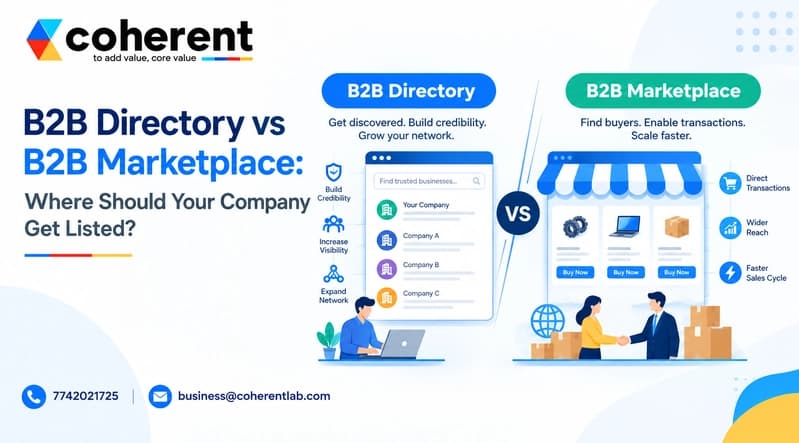
For many businesses, getting listed online sounds simple: find a popular platform, create a profile, add your services, and wait for leads.In reality, B2B directories and B2B marketplaces serve different purposes. A directory primarily help...
For many businesses, getting listed online sounds simple: find a popular platform, create a profile, add your services, and wait for leads.In reality, B2B directories and B2B marketplaces serve different purposes. A directory primarily helps buyers discover and evaluate businesses, while a marketplace is usually designed to facilitate commercial transactions between buyers and sellers.Choosing the wrong platform can mean spending time and money without generating meaningful business opportunities.The answer depends on your business model, target audience, sales cycle, industry, and goals. This guide explains the differences, advantages, costs, SEO benefits, and lead-generation potential of both options so you can make a smarter decision.
What Is a B2B Directory?
A B2B directory is an online platform where companies create business profiles to showcase their services, expertise, industries, locations, portfolios, and contact information.Think of it as a digital business directory specifically designed for companies looking for other businesses.For example, a buyer searching for a software development company in India may use a B2B directory to compare.The primary goal is business discovery and lead generation, rather than completing a transaction directly on the platform.
Services offered
Industry expertise
Location
Client reviews
What Is a B2B Marketplace?
A B2B marketplace is an online platform that connects business buyers with suppliers, manufacturers, wholesalers, service providers, or other sellers.Unlike a directory, a marketplace is usually more transaction-oriented.The platform may support a complete or partial B2B buying journey.For example, a manufacturer looking for bulk packaging materials could search a marketplace, compare suppliers, request quotations, and negotiate directly with vendors.
Search for suppliers
Compare products
Request quotations
Check prices
B2B Directory vs B2B Marketplace: Which One Should You Choose?
Choosing between a B2B directory and B2B marketplace depends on your business model, products or services, target customers, and buying process. Service-based businesses often benefit from directories that build credibility and generate inquiries, while product-based companies may prefer marketplaces designed for supplier discovery and transactions. Understanding your customer's search and purchasing behavior can help you select the platform that delivers better visibility and qualified leads.
Choose a B2B Directory If You Sell Services
A B2B directory is usually a strong option for professional service providers because buyers often research companies before requesting a consultation or proposal. A detailed profile can showcase expertise, experience, reviews, and portfolio work, helping prospects compare vendors and build trust before starting a business conversation.
Software development companies
Web development agencies
Digital marketing agencies
IT consulting companies
AI development companies
Choose a B2B Marketplace If You Sell Products
A B2B marketplace is often more suitable for companies selling physical, standardized, or wholesale products. Buyers can discover suppliers, compare products, review specifications, request quotations, and discuss orders. These platforms can therefore help product-based businesses reach high-intent buyers and generate opportunities across domestic and international markets.
Manufacturers
Exporters
Wholesalers
Distributors
B2B Directory Benefits for Companies
Getting listed on a reputable B2B directory can do more than provide another online business profile. It can improve brand visibility, support B2B lead generation, build credibility, and help companies reach buyers across local and international markets. A well-optimized listing also gives potential customers essential information about your services, expertise, reviews, location, and business capabilities before they make contact.
Improve B2B Online Visibility
A B2B directory gives your company another opportunity to appear when potential customers search for relevant services. An optimized business profile should clearly communicate what your company does and where it operates. Include important information such as:
Company name and website
Relevant service keywords
Industry specialization
Target geographic markets
Build Trust Through Reviews
Reviews provide important social proof when B2B buyers compare potential suppliers or service providers. Instead of relying only on promotional claims, prospects can see feedback from previous customers and better understand your company's reliability, communication, expertise, and service quality. A strong review profile can therefore increase credibility and make your B2B listing more persuasive.
Client satisfaction
Industry experience
Communication quality
Project delivery
Reach International Buyers
A well-maintained B2B directory profile can help companies reach customers beyond their local market. Businesses in India, for example, can target buyers searching for specific services and technology providers across the USA, UK, UAE, Australia, and other markets. This makes B2B directories useful for expanding international visibility and generating cross-border business opportunities.
IT companies in India
Software development companies in India
AI development companies in India
Web development companies in India
B2B Marketplace Benefits for Companies
B2B marketplaces help companies connect directly with businesses looking for products, suppliers, manufacturers, and wholesale solutions. Unlike traditional business directories, marketplaces often support product discovery, quotation requests, supplier communication, and purchasing activities. For product-based businesses, they can improve online visibility, attract high-intent buyers, expand market reach, and create more opportunities for qualified B2B sales and long-term commercial relationships.
Reach High-Intent Buyers
B2B marketplace visitors often have a specific purchasing requirement, making them valuable prospects for suppliers and manufacturers. Instead of casually researching companies, buyers may actively search for products, pricing, suppliers, or bulk orders. This can create stronger purchase intent and improve opportunities for businesses targeting qualified B2B customers.
Suppliers
Manufacturers
Products
Bulk orders
Showcase Products at Scale
A B2B marketplace allows companies to showcase multiple products through detailed listings rather than relying on one general business profile. Businesses can provide important product information that helps buyers compare options, understand specifications, and make purchasing decisions. This makes marketplaces particularly valuable for manufacturers, wholesalers, exporters, and product-based companies.
Product names
Technical specifications
Product images
Minimum order quantities
Receive RFQs and Supplier Inquiries
Many B2B marketplaces support Request for Quotation (RFQ) features that connect buyers with relevant suppliers. A buyer submits specific requirements, and qualified businesses can respond with pricing and product details. This can simplify supplier discovery, accelerate initial communication, and create valuable opportunities for manufacturers, wholesalers, exporters, and distributors.
Buyer requirements
Supplier responses
Product quotations
Pricing discussions
How to Choose the Right B2B Platform
Choosing the right B2B platform requires more than selecting the most popular directory or marketplace. Companies should consider their target audience, business model, competitors, buyer intent, lead quality, and expected return on investment. A platform that matches your industry and customer journey can generate better visibility and qualified leads, while the wrong platform may deliver traffic without meaningful business opportunities.
Check Your Target Audience
Understanding your ideal buyer is the first step when choosing a B2B platform. Identify where potential customers search, what they need, and whether they prefer services or products. This helps you select platforms that match your target market and increase the chances of attracting relevant business inquiries.
Ideal customer profile
Buyer search behavior
Product or service requirements
Analyze Competitors
Researching competitors can reveal which B2B directories and marketplaces are already generating visibility within your industry. Review their profiles, ratings, services, products, and customer feedback. If established competitors consistently receive attention from a particular platform, it may indicate strong buyer activity and make that platform worth testing.
Profile quality
Customer reviews
Ratings and rankings
Services or products listed
Evaluate Lead Quality
The number of leads alone does not determine whether a B2B platform is successful. Ten qualified prospects can be more valuable than hundreds of irrelevant inquiries. Track the complete customer journey to understand your actual ROI and identify which platforms generate meaningful business opportunities and conversions.
Listings
Profile views
Website visits
Leads
B2B Listing Strategy for Service Companies
Service companies should use B2B listings to showcase expertise, build credibility, and attract qualified business leads. A strong profile should clearly explain what the company offers, who it serves, and why buyers should choose it. Include relevant information such as:
Core services and technologies
Industry expertise
Target locations and markets
Portfolio and case studies
B2B Listing Strategy for Manufacturers
Manufacturers should use B2B listings to showcase products, production capabilities, and supplier expertise while attracting qualified wholesale buyers. A complete profile helps potential customers evaluate your business before making an inquiry. Highlight important information such as:
Product categories and specifications
Minimum order quantities
Manufacturing capacity
Certifications and quality standards
Final Verdict
There is no one-size-fits-all answer.Choose a B2B directory if your priority is company discovery, reputation, service-based lead generation, and vendor comparison.Choose a B2B marketplace if your priority is product discovery, supplier connections, RFQs, wholesale inquiries, and transactions.And if your business can benefit from both, use both strategically rather than treating them as competing channels.